
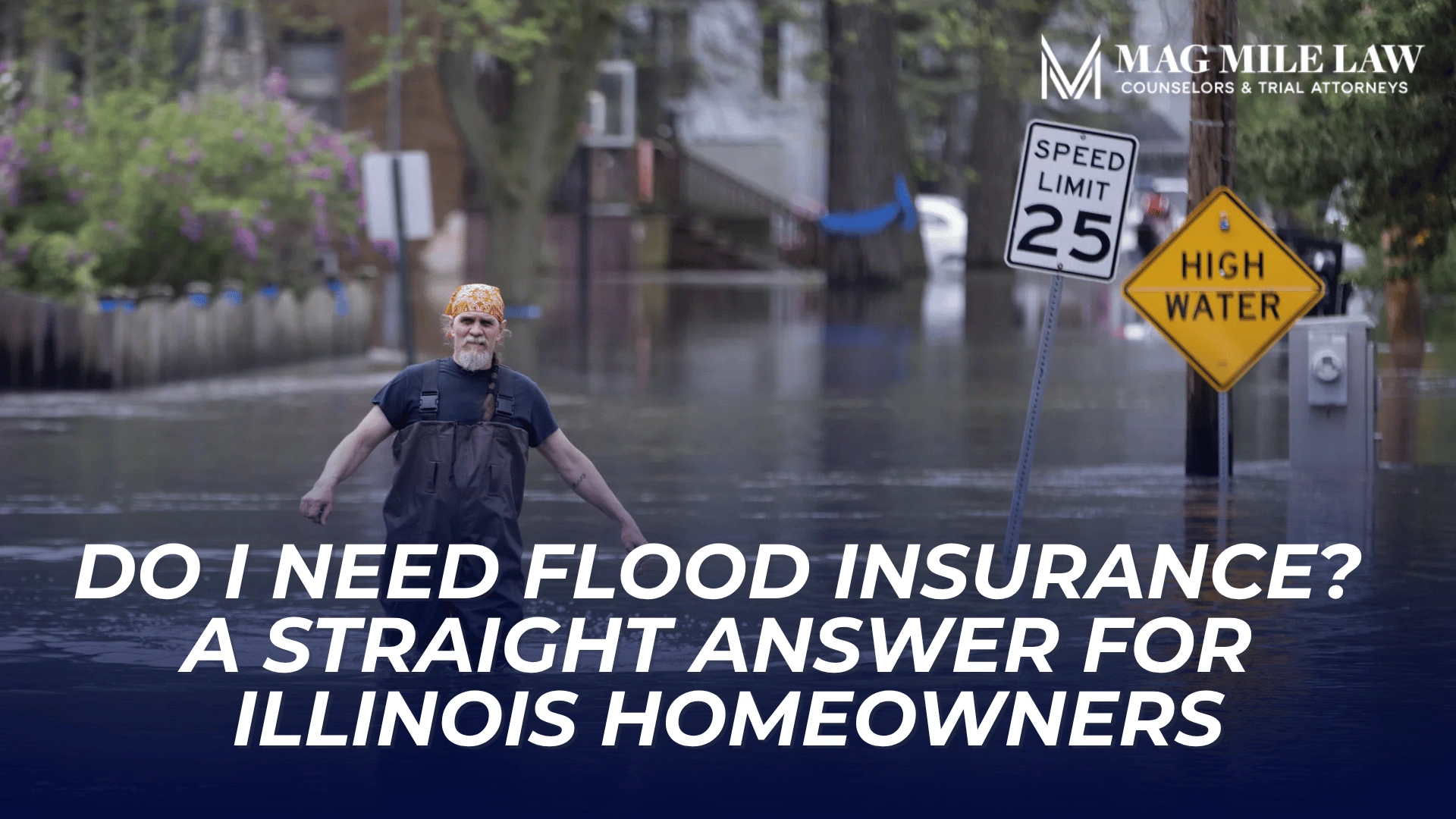
Probably yes — and not for the reason most people think. Your standard homeowners policy almost certainly does not cover flood damage. So if rising water, a flash flood, or an overwhelmed sewer sends water into your home, you’re paying out of pocket unless you carry a separate flood policy. Whether the law requires you to buy one is a narrower question than whether you actually need one. Those two answers often point in opposite directions.
Below: what your homeowners policy really covers, what legally counts as a “flood,” when a lender can force you to buy coverage, why being outside a flood zone doesn’t mean you’re safe (especially in Illinois), what a policy costs and covers, and what happens financially if you skip it.
Does my homeowners insurance already cover flooding?
No. Standard homeowners insurance in Illinois excludes flood damage — this is one of the most common and expensive misconceptions homeowners have. Wind damage from a storm is typically covered; water that rises up from the ground and enters your home is not.
That gap is deliberate and nearly universal. Even comprehensive homeowners policies exclude flooding caused by rising water. Wind tears off shingles and rain comes through the hole — covered. A creek jumps its banks or a downpour overwhelms the storm sewer and water backs into your basement — not covered.
There’s a second gap that catches a lot of Illinois homeowners specifically. Sewer and sump-pump backup is the single most common way Chicago-area homes take on water. It’s excluded by both a standard homeowners policy and a standalone flood policy. It requires its own separate water-backup endorsement added to your homeowners coverage. So “do I need flood insurance” is really two questions: do you need flood coverage, and do you need a backup endorsement. For many Illinois homes, the honest answer is both.

What actually counts as a “flood”?
A “flood,” in insurance terms, is a temporary inundation of normally dry land by water that comes from outside your home — rising rivers, storm surge, flash flooding, or surface water pooling and entering the structure. The federal definition generally requires the water to affect two or more acres or two or more properties. That’s why a single burst pipe inside your house is not a flood.
This distinction is not just theoretical. It decides which policy pays. Water damage from a burst pipe, a failed water heater, or wind-driven rain entering through storm-damaged roofing is usually a homeowners claim. Water that rises from the ground or arrives as surface runoff is a flood claim. The same puddle on your floor can be covered or excluded depending entirely on where the water came from. That boundary is exactly where disputes with insurers start.

Am I required to have flood insurance?
Only in one situation: if your home sits in a FEMA-designated high-risk flood zone (a Special Flood Hazard Area) and you have a federally backed mortgage. In that case your lender is legally required to make you carry flood insurance as a condition of the loan. Everywhere else, it’s optional.
A few things worth knowing about that requirement:
- It’s the lender’s rule, enforced by federal law — not a personal choice. If your coverage lapses on a property subject to the mandatory-purchase requirement, the lender must notify you and can “force-place” a policy on your behalf. That coverage usually costs more, with terms written to protect the lender, not you.
- It can appear mid-loan. Lenders monitor flood-zone status over the life of the loan. A property remapped into a high-risk zone after closing can trigger a new requirement years in.
- Private policies can satisfy it. Federal law requires lenders to accept a qualifying private flood policy in place of an NFIP policy, as long as it meets the equivalence standard. That’s useful if you need more coverage than the federal program offers.
If no one is requiring you to buy it, the question shifts from “must I?” to “should I?” That’s where most Illinois homeowners get the wrong answer.

I’m not in a flood zone — do I still need it?
Very possibly, yes. The idea that flood risk lives only inside mapped high-risk zones is wrong, and in Illinois it’s dangerously wrong. Nationally, from 2014 to 2024, nearly one-third of all federal flood-insurance claims came from areas outside high-risk flood zones.
Illinois is worse than the national average, because most of the state’s flooding is urban flooding — heavy rain overwhelming aging storm sewers, far from any river. Consider what the local data shows:
- An Illinois Department of Natural Resources study found that 90% of flood-damage claims in the Chicago area between 2007 and 2014 were for properties located outside the mapped 100-year floodplain.
- Flooding cost Illinois more than $3 billion in damages between 2000 and 2018 — more than any state outside the hurricane-battered Gulf Coast.
- The problem is accelerating. Over the past century in Chicago, the likelihood of heavy rainstorms has increased sevenfold. A single July 2023 storm flooded at least 70,000 West Side and suburban basements. Most were uninsured, because private insurance generally doesn’t cover flood damage and federal aid was slow to arrive.
If you own a home with a basement anywhere in the Chicago metro or Fox Valley, “I’m not in a flood zone” is not a reason to skip coverage. It mostly means your risk isn’t reflected on a map.

How do I find out my actual flood risk?
Start with your FEMA flood zone, then treat it as a floor, not a ceiling. You can look up your address on FEMA’s Flood Map Service Center or at FloodSmart.gov. That tells you whether you’re in a high-risk zone (labeled A or V), a moderate-to-low-risk zone (X, B, or C), or an undetermined area.
Two cautions. First, the maps lag reality: many Chicago-area neighborhoods that flood routinely are not designated high-risk on FEMA maps. That’s largely because the maps focus on river flooding and don’t fully capture sewer-driven urban flooding. Second, “undetermined risk” doesn’t mean “no risk” — it means the analysis hasn’t been done.
The practical move: check your FEMA zone, then ask your neighbors and your municipality whether your street has a basement-backup or ponding history. Local memory often tells you more than the federal map does.

What does flood insurance cost and what does it actually cover?
Coverage comes from two places — the federal National Flood Insurance Program (NFIP) or private insurers. If you’re in a lower-risk area, the price is often surprisingly modest, sometimes a few hundred dollars a year. But the coverage has real limits you need to understand before you rely on it.
Here’s what an NFIP policy does and doesn’t do:
- Coverage caps. Residential building coverage tops out at $250,000 and contents coverage at $100,000. If your home is worth more than that to rebuild, you have a gap. That’s where private flood insurance, often offering higher limits, becomes worth comparing.
- A waiting period. NFIP policies typically don’t take effect for 30 days. You cannot buy a policy when the forecast turns bad and expect it to cover the storm that week. This is the single most common way people get caught.
- Depreciated contents payouts. NFIP contents claims are settled at actual cash value — meaning depreciation is subtracted — not replacement cost.
- Limited basement coverage. An NFIP policy covers specific basement building items like the furnace, water heater, and central air, plus cleanup costs. It doesn’t cover personal property stored there or finished elements like carpet. In Illinois, where finished basements are everywhere, this matters a lot.
One timing note for anyone deciding right now: the NFIP’s authorization is currently set to expire September 30, 2026. Existing policies stay in effect, and claims keep being paid. Private flood insurance is unaffected. But if you’re buying or renewing this fall, confirm the program’s status with your agent and consider a private quote as a backstop.

What happens if I skip it and my home floods?
You absorb the loss yourself — and flood losses are large. From 2020 to 2024, the average federal flood-insurance claim payment was $82,614. A single inch of floodwater can cause roughly $25,000 in damage to a home.
The dangerous assumption is that federal disaster aid will bail you out. It usually won’t, not in the way people imagine. When disaster assistance is available at all, it typically comes as a loan you have to repay with interest — not a check. And it only exists if a federal disaster is declared, which routine basement flooding rarely triggers. After the 2023 West Side flooding in Chicago, many homeowners cleaned up the damage on their own because private insurance didn’t cover it and federal aid was delayed.
So the real trade-off isn’t “premium versus nothing.” It’s a few hundred dollars a year versus a five-figure repair bill you pay yourself, possibly financed at interest.

What should I do next?
Three concrete steps:
- Look up your flood zone at FloodSmart.gov, then ask around your block about basement-backup and ponding history. Treat the map as the floor of your risk, not the full picture.
- Get a quote for both flood coverage and a water-backup endorsement. Note the 30-day NFIP waiting period, so you’re covered before storm season, not during it.
- Review your homeowners policy’s water-damage and flood language so you know, before anything happens, exactly where the covered/excluded line falls for your home.
That last step is where experienced counsel can help. Mag Mile Law, based in Chicago, handles first-party property insurance disputes — including water-damage, storm, and coverage-denial claims — and the classification question this article turns on: whether a given water loss is a covered homeowners claim or an excluded flood loss. The firm’s attorneys bring relevant credentials to reading that line. Partner Steven Mikuzis is both a litigator and a licensed property-and-casualty insurance producer, giving the firm inside knowledge of how carriers investigate and characterize claims, and founding partner Mario Iveljic is a lead litigator who also holds a property-and-casualty insurance producer’s license. The firm’s results include a $2,394,290 fire-insurance recovery, reflecting the kind of first-party disputes it handles. If you have questions about how your policy would treat a water loss — or a claim has already been denied or lowballed — you can reach Mag Mile Law through magmilelaw.com.

This article is general legal and insurance information, not legal advice, and reading it does not create an attorney-client relationship. Policy terms, flood-zone designations, and program rules vary and change; consult a licensed attorney or insurance professional about your specific situation and your actual policy language.