After a hailstorm rolls through Illinois, one of the first things you need to do is check your roof. Knowing what hail damage looks like can mean the difference between a paid insurance claim and a denial letter. The signs are not always obvious from the ground — and insurance companies know that.
According to the Insurance Information Institute (2023), wind and hail caused 32.6% of all homeowners insurance claims in 2023. Verisk’s 2024 Roofing Realities Report found that U.S. residential roof claim costs reached roughly $31 billion that year — a jump of about 30% in just two years. If hail hit your area, your roof may have damage worth thousands of dollars. But you need to know what to look for, how to record it, and what your insurer owes you.
How to Spot Hail Damage on Different Roofing Materials
Not every roof shows hail damage the same way. The signs depend on what your roof is made of. Here is what to look for on the most common types.
What does hail damage look like on asphalt shingles?
Asphalt shingles are the most common roofing material in Illinois. Hail hits leave dark spots where the protective granules have been knocked loose. These marks are usually round, random in pattern, and soft to the touch — like a bruise on an apple. You may also see exposed black substrate underneath. Over time, granule loss speeds up shingle wear. That means even small hail impacts can shorten your roof’s life by years.
What does hail damage look like on metal roofs?
Metal roofs show dents or dimples where hailstones struck. The dents are usually round and vary in size based on how large the hail was. On softer metals like aluminum, you may see deeper impressions. On steel panels, dents may be shallow but still visible at an angle. Cosmetic dents can weaken the panel’s protective coating over time and cause rust.
What does hail damage look like on wood shingles and flat roofs?
Wood shakes and shingles show splits or cracks along the grain after hail impact. According to the Haag Engineering Protocol for Assessment of Hail-Damaged Roofing, hail-caused splits are identifiable by their sharp edges and the fresh, unweathered wood exposed underneath — typically orange in color, turning gray after six to twelve months of exposure. Natural weathering cracks, by contrast, have smooth edges and gray wood throughout. You may also see pieces of wood broken away along the edges of the opening. On flat roofs or rubber membrane systems, look for punctures, circular cracks, or soft spots. Built-up roofs may show dents in the surface layer. Each material leaves different clues, so knowing what is normal wear versus storm impact matters for your claim.
What Other Parts of Your Roof Should You Check?
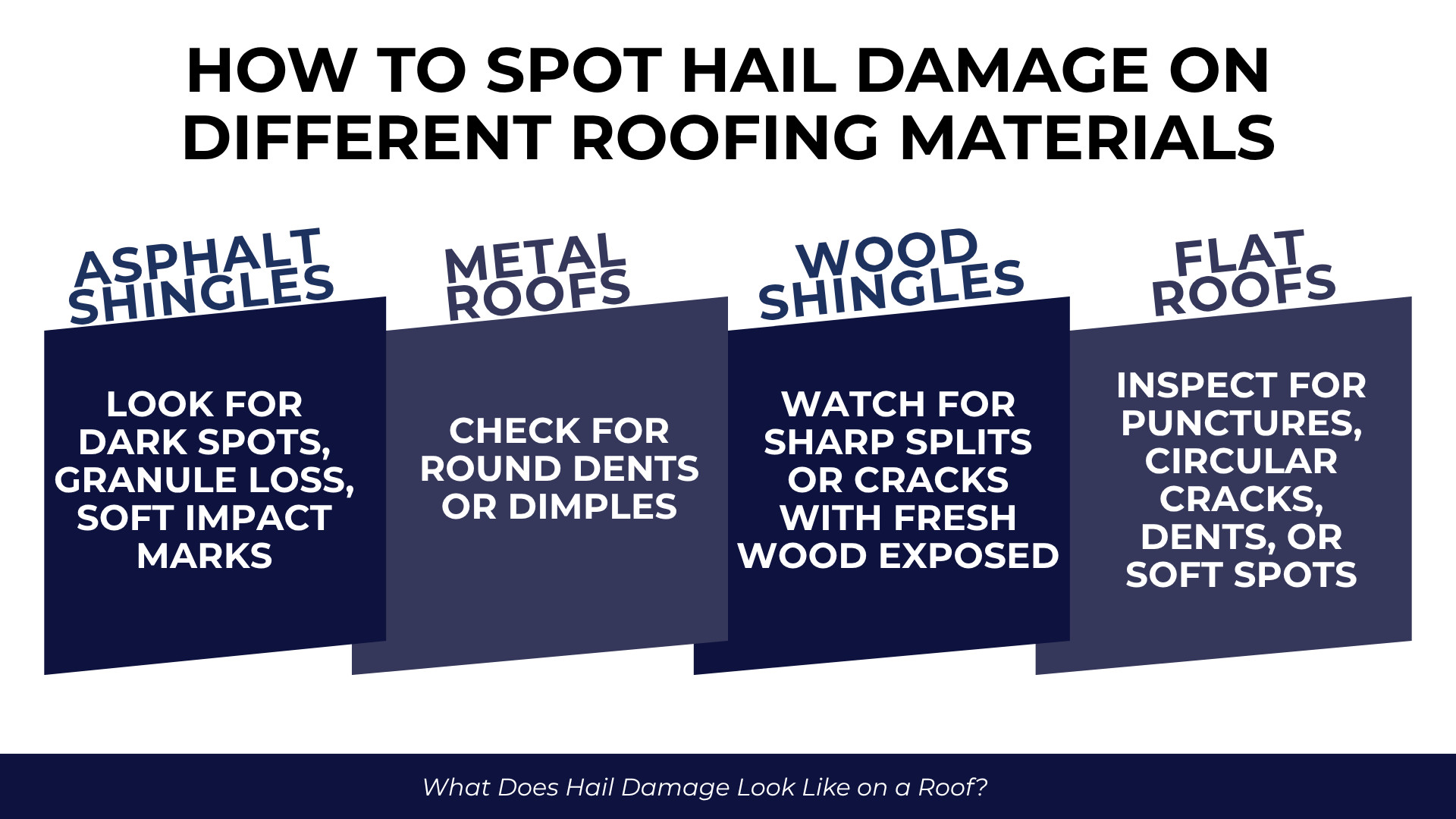
Hail does not just hit shingles. Other roof parts take damage too, and these items are often covered under your policy.
Can hail damage gutters, vents, and flashing?
Yes. Gutters often show the clearest signs of hail — dents and dings along the top edge and downspouts. Roof vents, pipe boots, and metal flashing around chimneys may have dents, cracks, or holes. These parts are easier to see from the ground or a ladder than the shingles themselves. Damaged flashing can let water into your home, so this is not just cosmetic.
Should I check my siding and windows too?
Dents in vinyl or aluminum siding, cracked window frames, and pockmarked windowsills can all support your roof claim. They show the storm was severe enough to cause damage to your property. Adjusters look at these “collateral” indicators when they judge whether hail hit hard enough to damage your roof, so take photos of everything you find — including outdoor AC units and window screens.
What size hail actually damages a roof?
One-inch hail — about the size of a quarter — is the threshold where most roofing materials start showing damage. According to the National Weather Service (2005–2024), the northern Illinois forecast area sees 10 to 15 days per year with at least one report of damaging hail at that size or larger. According to the Illinois State Climatologist (1995), Illinois averages about 2.0 to 2.5 hail days per year statewide. But the Chicago area and Cook County get hit more often, and hailstones of two inches or more can cause severe damage in a single storm.
How Should You Document Hail Damage for Your Insurance Claim?
The way you document your damage can make or break your claim. Your insurer will want evidence that hail — not wear and tear — caused the problem.
What photos and records should I keep?
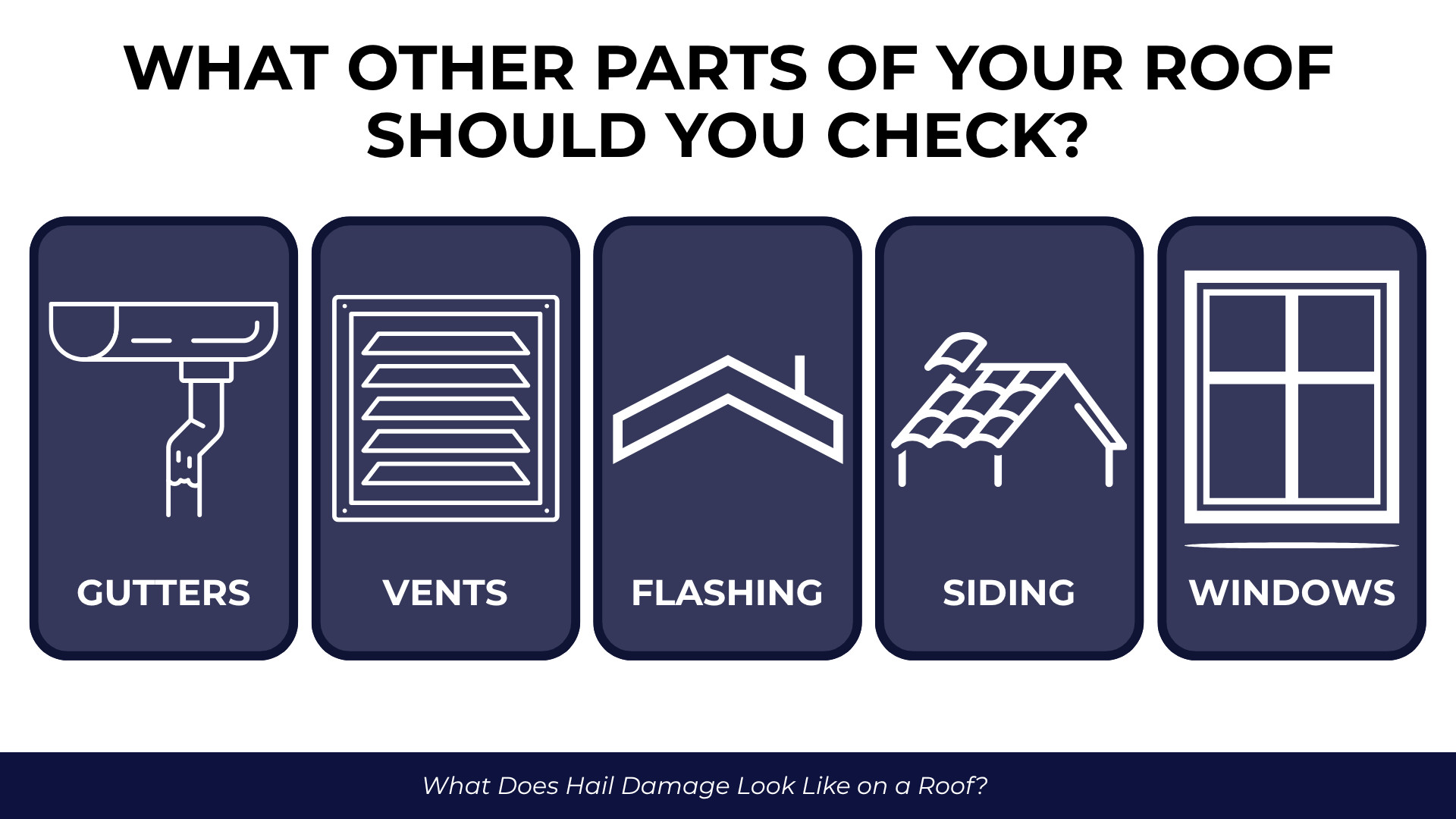
Take photos of every damaged area as soon as it is safe to go outside. Include:
- Wide shots of the full roof and close-ups of each impact mark
- Gutters, vents, siding, and any ground-level evidence like hailstones (place a coin next to them for scale)
- Weather alerts and storm reports from the National Weather Service for your ZIP code
- Date-stamped photos — your phone does this automatically
If you had a recent roof inspection showing your roof was in good shape before the storm, keep that report. It is strong evidence that the damage is new.
When do I need to notify my insurance company?
As soon as you spot damage. Illinois does not set a fixed deadline for reporting a hail claim, but delay can hurt you — under Country Mut. Ins. Co. v. Livorsi Marine, Inc., 222 Ill. 2d 303 (Ill. 2006), unreasonably late notice can forfeit coverage entirely, even if the insurer was not prejudiced by the delay.
Once you report, the clock starts on your insurer. Under 50 Ill. Admin. Code § 919.40, it has 15 working days to respond and 21 working days to begin a prompt investigation. § 919.50 requires payment of any undisputed amount within 30 days of affirming liability and a written explanation within 30 days of any denial. Missing these deadlines does not make the insurer automatically liable, but it can be evidence of vexatious and unreasonable handling under Section 155.
Is a sworn proof of loss required?
Most policies require a signed, sworn, notarized proof of loss within 60 days. Filing it also starts the clock on a key protection — under 215 ILCS 5/143.1, your deadline to file suit pauses from the date you submit your proof of loss until the insurer denies your claim (in whole or in part). In McMahon v. Coronet Ins. Co., 6 Ill. App. 3d 704, 286 N.E.2d 631 (1st Dist. 1972), the court found that an insurer that bases its denial on grounds other than the insured’s failure to file proof of loss gives up the right to enforce that requirement. Still, do not gamble on that outcome. File a proper proof of loss to protect yourself.
How Do Insurance Companies Inspect and Evaluate Hail Damage?
Your insurer’s inspection process matters as much as the damage itself. An incomplete inspection is one of the most common reasons hail claims get underpaid or denied.
What should a proper roof inspection include?
A proper inspection means an adjuster physically climbs onto your roof and examines it. They should check every slope, not just the side facing the storm. They should inspect shingles, flashing, vents, gutters, and any soft metals. If your adjuster spent 20 minutes on a 3,000-square-foot roof, the inspection may have fallen short — and that matters legally. In McGee v. State Farm Fire & Cas., 315 Ill. App. 3d 673, 734 N.E.2d 144 (2d Dist. 2000), the court held that the thoroughness of an insurer’s investigation is central to deciding whether its conduct is vexatious and unreasonable under Section 155. A rushed or incomplete inspection can be evidence that the insurer failed to meet its obligations under 215 ILCS 5/154.6, which prohibits improper claims practices.
If the insurer concludes that wear and tear — not hail — caused the damage, Illinois law places the burden on the insurer to prove that exclusion applies. And if your policy contains an anti-concurrent causation clause, that defense has limits — particularly when hail alone caused the damage and wear was just a pre-existing condition. For a full breakdown of how Illinois courts handle causation disputes in hail claims, see our guide on hail damage insurance claims in Illinois.
Why Does Hail Damage Get Worse Over Time?
Hail damage on a roof is not a problem that stays the same. It grows if you do not address it.
How does unrepaired hail damage cause bigger problems?
Cracked or dented shingles lose their ability to keep water out. Granule loss exposes the material underneath to UV rays, which breaks it down faster. Small cracks in flashing become entry points for rain. Over months, what started as cosmetic damage turns into leaks, ceiling stains, and rotting decking. Repairing these secondary problems costs far more than fixing the original hail hits — and the longer you wait, the worse it gets.
Does waiting to file hurt my claim?
Yes — and it can cost you coverage entirely. Most homeowners policies set a suit-filing deadline of one to two years from the date of loss. As previously noted, the court in Livorsi held that unreasonably late notice can forfeit coverage even if the insurer was not harmed by the delay. The sooner you file, the easier it is to prove the storm caused it.
Can construction costs affect my payout?
According to the BLS/AGC (2026), the Producer Price Index for asphalt roofing materials has risen 38.4% since February 2020. If your insurer based its estimate on outdated pricing — or used cost databases that have not kept up with inflation — your payout may be too low. The gap between what the insurer offers and what a roof replacement actually costs is a frequent source of underpayment disputes in DuPage, Lake, and Will Counties and across the Chicago metro area.

Frequently Asked Questions
How can I tell the difference between hail damage and normal roof aging?
Hail marks are round, randomly scattered, and concentrated on the side of the roof facing the storm. Normal aging looks different — it causes even granule loss across the entire surface, curling at shingle edges, and uniform fading. Hail impacts also leave soft spots you can feel with your fingers. A professional roofer can map the strike pattern to match the storm’s direction, which is strong evidence for your claim.
Should I get my own roof inspection before the adjuster arrives?
Yes — hiring an independent roofer to inspect your roof before the insurer’s adjuster visits gives you a baseline. The roofer can document every impact, mark damaged areas, and prepare a written report with photos. If the adjuster’s findings differ sharply from your roofer’s report, you have evidence to push back. This is especially helpful in disputes over the scope of damage.
How long does it take to resolve a hail damage claim in Illinois?
According to J.D. Power’s 2024 Property Claims Study, the average claim takes 23.9 days from report to finished repairs — but catastrophe-related claims average 34.2 days. Disputed hail claims can take much longer, especially if the insurer challenges causation or the amount of loss. Filing promptly, documenting thoroughly, and responding quickly to insurer requests all help keep the timeline shorter.
What if my hail damage claim is denied?
A denial is not the final word. Check whether the letter cites specific policy language — Illinois regulations require it. You may also have options through the appraisal process or under Section 155 if the denial lacked a genuine basis. For a full breakdown of your rights after a denial, see our guides on hail damage insurance claims in Illinois and [bad faith insurance claims in Illinois
Talk to an Illinois Property Insurance Attorney
Spotting hail damage on your roof is only the first step. The harder part is proving it to your insurance company and getting paid what your policy says you are owed. Mag Mile Law focuses on property insurance coverage disputes for Illinois homeowners. Steven Mikuzis earned his J.D. cum laude with honors from Chicago-Kent College of Law, where he received the CALI Award for Trial Advocacy. He holds an insurance producer license and is admitted to the Seventh Circuit and the Northern District of Illinois. Mario Iveljic holds a B.A. in Economics from Yale University and a J.D. cum laude from Chicago-Kent College of Law. With more than two decades of insurance litigation experience, he is admitted to practice before the Illinois Supreme Court, the Seventh Circuit, and federal courts across Illinois. To discuss your options after a denied or underpaid hail claim, contact Mag Mile Law at (773) 644-9593.